Author: Chuck (Page 6 of 6)

The Aptitude of Jews and Gentiles at Selective Universities in the US

(and Some Other Stuff)

I had noted previously that there is diminishing interest in classic HBD topics, such as race and IQ. And I pointed out elsewhere that virtually no one in the US with an IQ above the 85th percentile currently takes the hereditarian position on race and IQ seriously, at least as judged by the General Social Survey 2012 responses. So, perhaps, the views of HBD proponents are finally coming in line with those of the vast majority of the US population. Indeed, one of the leading minds in this field has recently stated:

Like many of us who are fascinated with human diversity, she has little or no interest in what are called race differences…. No one it seems cares much about that any longer. (Harpending, H. (April 14, 2013). West Hunter).

This increasing disinterest might explain why my colleague’s recent eloquent defense of general intelligence netted 53 comments while my post on my exhaustive analysis of color and IQ amongst siblings of different races, a topic hitherto never explored, netted precisely 0. There are other possible reasons for this, of course. Whatever the case, the nexus between race and IQ doesn’t seem to be as popular of a topic as it once was so it seems that I will do less unwell if I shift my focus elsewhere.

One race unrelated issue worth further exploring is that of Jews, meritocracy, and elite admissions. Continue reading

Pigmentocracy: A Longitudinal Approach

Introduction

We have shown, amongst other things, that pre-market measures of IQ substantially statistically explain the association between color and outcomes in the US. This implies that the adult color-outcome differences are substantially caused by IQ differences, rather than vice versa. To investigate this issue further, I have taken a longitudinal approach.

As background, it is well established that the year to year correlation for IQ is mediated by general intelligence on the psychometric level and by shared genes and shared environment on the causal levels. The latter two sources contribute to the longitudinal stability of IQ. Unshared environment, on the other hand, does not. This situation is illustrated in the table immediately below. As is shown, the longitudinal stability of IQ scores for both Blacks and Whites is conditioned by genetic and shared environmental effects. For the Add Health sample, in particular, unshared environment contributes only to longitudinal change.

acestabilitychange

(From: Beaver, et al. (2013). The genetic and environmental architecture to the stability of IQ: Results from two independent samples of kinship pairs. Intelligence, 41(5), 428-438.)

It follows then that if differences are due to shared genes and shared environment, as we propose, then the IQ-color association should be largely on a factor common across ages. Moreover, IQ at earlier ages should explain some of the IQ-color correlations at a latter ages. Overall, the association between color and IQ should have longitudinal stability. It is, of course, not necessary that it does. If, for example, labor marker color discrimination was leading to outcome differences which were, in turn, leading to IQ difference, the pre-market and post-market color-IQ correlations would not be mediated by a common factor. Likewise, if idiosyncratic individual factors such as peer group influences were conditioning the differences, one would not expect longitudinally stable color associated IQ differences (since such idiosyncratic influences don’t condition longitudinally stable IQ differences).

Continue reading

Color Differences: Ubiquitous Yet Understudied

Note: Our analysis has been updated and extended. Refer also to: Color Differences: Corrections and Further Analysis. Part 1

(or Colorism: Game Over)

Introduction

Following up with Dalliard’s pioneering post on colorism, we looked at the relationship between skin color, cognitive ability, and educational attainment in the full NLSY 97 sample (across all racial and ethnic groups). Our purpose was to test what we term “Strong Colorism”. According to “Strong Colorism”, color discrimination is a unifying explanation for sub-population differences in the US and beyond; it is a generalized phenomenon that can account for pigment related outcome differences. Lest readers suspect that a straw position is being constructed, below is an excerpt from an article, recently published in the journal of Industrial and Organizational Psychology, discussing this model (which the authors take to be established):
Continue reading

More than Just “Colorism”: Part 1.

The meaning of a Jensen Effect on the Color Effect

Dalliard showed that IQ correlates with color in both the American Black and Hispanic populations (a color effect) and, importantly, that the IQ-color correlations are positively related to a subtest’s general intelligence loading (a Jensen effect). In short, he showed that there was a Jensen effect on the IQ color effect. This is significant for reasons elaborated elsewhere. Generally, if an IQ difference is strongly positively correlated with g – is g(+) – biological causation is implicated; alternatively, if an IQ difference is strongly negatively correlated with g – is g(-) – cultural causation is implicated. Here, “biological causation” refers to psychophysiological influences on mental states that do not act through sensory informational pathways, while “cultural causation” refers to psychophysiological influences on mental states that act through these pathways; as an example of the general biological versus cultural causal schema, with respect to personality, differences induced by pharmacological agents would be classed as “biological causal” while differences induced by psychotherapy would be classed as “cultural causal.” This schema, of course, isn’t perfect – but it has utility and is not infrequently employed in psychology.
Continue reading

The Limits of Selectivity

Figure 1 below shows the last five years of SAT scores for African Americans who were a part of the Department of Defense educational system (DoDEA) and for those who were not (Nation). The former, the children of enlisted personal, perform almost 0.3 standardized units better than the latter. Elsewhere, I have documented that this 0.3 difference can be found in DoD schools both in the US and abroad.

Figure1.  SAT

An obvious explanation for the DoDEA/ Nation difference is parental selectivity. Entrance into the military is mostly limited to those with AFQT z-scores above -1 relative to a US national mean of 0. As the Black cognitive ability mean is about -1, on the same scale, only the upper half of the Black population is qualified for entrance into the military; as a result, Africa American recruits represent, on average, the 75th percentile of the Black cognitive ability distribution. As such, those selected should be about 0.67 SD (standardized units) above the African-American mean. Given the coefficient of assortative mating typically reported in the literature of 0.33, and assuming a trivial number of Military-Military parings, a random pair of African Americans, for which one individual is or was a member of the military, should have a mid parent IQ 0.45 SD above that of a random pair for which neither individual is or was a member of the military. Multiplying by the typically found coefficient of regression of 0.6 gives one a military, non-military offspring difference of about 0.27 – and this would account for the DoDEA/Nation difference in full. In theory. Continue reading

Fuzzy Wuzzy was a bear….

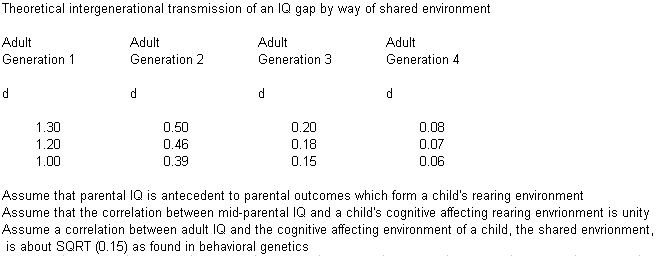
GC maintains that the Hispanic-White IQ difference fails to converge by the fourth generation. If so, this would be informative as to the etiology of the differential. I articulated why in a previous post. IQ differences between families, within populations are poorly environmentally transmitted across generations. This is because the environmental correlation between parents and offspring is low. The situation is depicted below:

generationxIQgapifSE
Continue reading

It is not the purpose of this book to prove that Negroes are socially, morally, or intellectually inferior to whites; nor is its purpose to demonstrate that Negroes are the equal of or are superior to whites in these several characteristics. Rather, it is the intention of the writer to convey with some degree of clarity and order the results of many years of research on one aspect of Negro behavior and to assess objectively the ever growing literature on this subject. — Shuey (1966). The Testing of Negro Intelligence.

I felt unsatisfied with my last attempt so I decided to conduct a more complete review. This is my most recent version of TNI (Testing Negro Intelligence). I was able to cover every major sample prior to 1980 and nearly every major sample up until the 1990s. I included, along with a plethora of other studies, two major reviews and three meta-analyses. To this I added my own analysis of the publicly available NALS and NAAL and a mini-meta-analysis covering the years 2004 to 2012. This review is based on over 700 samples of which over 60 are nationally representative. It’s so large that it doesn’t fit on my screen — and perhaps yours too. As such, I attached my excel file for interested readers. (Excel File here.)
Continue reading

Newer posts »

© 2026 Human Varieties

Theme by Anders NorenUp ↑